
Plasma GFAP Lumipulse Test for Preclinical Alzheimer's Detection

SNIPPET: Plasma GFAP measured on the automated Lumipulse G600II platform can detect astrocytic reactivity in cognitively unimpaired individuals with preclinical Alzheimer's pathology, achieving an AUC of 0.67 for amyloid-positive discrimination and showing 0.96 correlation with research-grade SIMOA assays — promising for clinical screening but insufficient as a standalone diagnostic.
THE PROTOHUMAN PERSPECTIVE#
Here's what most people miss about Alzheimer's biomarkers: the disease is doing damage for 15 to 20 years before anyone notices a single symptom. By the time you forget where you parked, amyloid plaques and tau tangles have been silently dismantling synaptic architecture for over a decade. The entire frontier of neurodegeneration research isn't about treating symptomatic patients better — it's about finding the people who don't know they're sick yet.
That's why plasma GFAP matters. It's a blood-based signal of astrocyte activation — the brain's glial housekeeping cells going haywire in response to amyloid accumulation. And now, for the first time, we have data showing that a fully automated, clinic-ready platform (Lumipulse) can measure it with near-identical accuracy to research-only assays. This shifts the conversation from "interesting lab finding" to "something your neurologist might actually order." The catch, though: the diagnostic accuracy alone isn't enough to screen populations. It's a piece of a panel, not a silver bullet. And that distinction matters enormously for anyone tracking their own cognitive trajectory.
THE SCIENCE#
What Plasma GFAP Actually Tells You (And What It Doesn't)#
Glial fibrillary acidic protein is an intermediate filament protein expressed predominantly by astrocytes. When astrocytes become reactive — a process called astrogliosis — GFAP production ramps up, and measurable quantities spill into the bloodstream. In the context of Alzheimer's disease, this astrocytic reactivity appears tightly coupled to amyloid-β deposition, making plasma GFAP a proxy signal for the earliest stages of AD pathology[1][2].
But here's where I need to be specific about what "proxy" means. Plasma GFAP doesn't tell you that you have Alzheimer's. It tells you that your astrocytes are activated in a pattern consistent with amyloid pathology. Other conditions — traumatic brain injury, multiple sclerosis, other neurodegenerative diseases — also elevate GFAP[3]. Which is annoying, actually, because it means the biomarker's specificity for AD requires additional context from other markers.
The Lumipulse Validation: Numbers That Matter#
The March 2026 study published in Alzheimer's Research & Therapy evaluated 204 cognitively unimpaired (CU) individuals using the Lumipulse G600II platform[1]. This is critical context: these weren't patients with dementia. These were people who appeared cognitively normal but may have had underlying amyloid or tau pathology detectable via CSF biomarkers.
The key findings:
- Amyloid-positive (A+) individuals had significantly higher plasma GFAP than amyloid-negative (A−) subjects: 64.7 vs. 47.6 pg/mL (p = 0.001)
- Tau-positive (T+) subjects also showed elevated GFAP: 64.3 vs. 48.5 pg/mL (p = 0.005)
- A+T+ individuals (both amyloid and tau pathology) showed the largest separation from A−T− controls: a mean difference of 22.2 pg/mL (Cohen's d = 0.81, p < 0.0001)
- After adjusting for age, sex, and ApoE ε4 status, the A+T+ vs. A−T− difference remained significant (estimate = 14.5 pg/mL; p = 0.005)
The AUC for discriminating amyloid-positive from amyloid-negative status was 0.67 (95% CI: 0.59–0.76)[1].
Let me be honest: an AUC of 0.67 is not going to replace PET imaging or CSF analysis. It's better than a coin flip but not by the margin you'd want for population-level screening. For context, plasma p-tau217 — the current leading blood biomarker for AD — achieves AUCs exceeding 0.9 in comparable settings[2]. So why does GFAP matter at all?
Because it's measuring something different. P-tau217 tracks tau phosphorylation driven by amyloid. GFAP tracks the neuroinflammatory response to that pathology. They're complementary signals, not competing ones. And the KBASE cohort data from npj Dementia suggests GFAP may serve a dual mechanistic role — both mediating the relationship between amyloid and tau, and moderating how tau pathology translates into metabolic dysfunction and hippocampal atrophy[4].
Platform Concordance: Lumipulse vs. SIMOA#
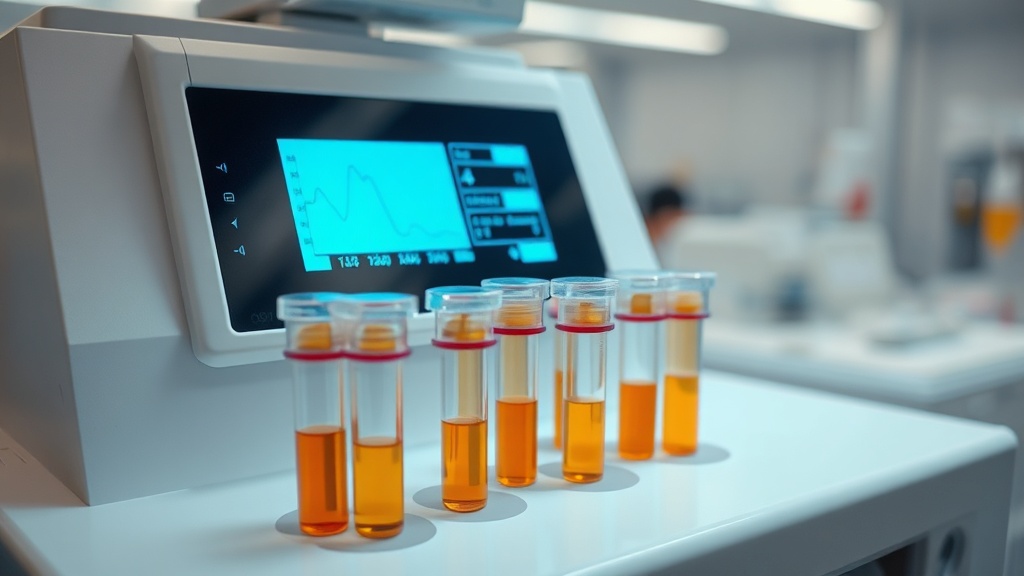
One of the most clinically relevant findings is the head-to-head comparison between Lumipulse (automated, clinic-ready) and SIMOA (research-grade, ultrasensitive). In a subset of 143 participants[1]:
- Pearson correlation: r = 0.96 (p < 0.001)
- 97% of paired measurements fell within Bland–Altman limits of agreement
- Passing–Bablok regression showed slight proportional bias — meaning the two platforms don't produce identical absolute values, but they track each other almost perfectly
This is the finding that matters most for clinical translation. SIMOA has been the reference standard for blood-based neurodegeneration biomarkers, but it requires specialized equipment and trained operators. Lumipulse runs on the same automated platform already deployed in thousands of clinical labs worldwide for routine CSF AD biomarker testing. The infrastructure exists. The assay just needs to be added.
The Mechanistic Layer: GFAP as More Than a Passive Marker#
The KBASE cohort study (92 older adults with multimodal PET imaging) revealed something that shifts how I think about GFAP in the AD cascade[4]. Mediation analyses showed that plasma GFAP significantly explained the statistical relationships between amyloid burden and tau accumulation, and between tau and cerebral glucose hypometabolism. In plain language: astrocytic reactivity appears to be an active link in the chain from amyloid to tau to neurodegeneration — not just a bystander signal.
Moderation analyses added a twist. Higher GFAP strengthened the amyloid–tau association (accelerating the cascade), while simultaneously appearing to buffer tau-related metabolic decline. The authors describe this as a "dual role" — GFAP as both conduit and regulator[4]. I'm less convinced by the protective interpretation given the sample size (n = 92), but the mechanistic framing is worth watching in larger cohorts.
Plasma GFAP Levels by AT Status (Lumipulse)
COMPARISON TABLE#
| Method | Mechanism | Evidence Level | Cost | Accessibility |
|---|---|---|---|---|
| Plasma GFAP (Lumipulse) | Astrocytic reactivity marker; correlates with amyloid/tau burden | Single validation study in CU (n=204); AUC 0.67 | Low–moderate (automated blood test) | High — existing lab infrastructure |
| Plasma GFAP (SIMOA) | Same biomarker, ultrasensitive single-molecule detection | Multiple research cohorts; well-established correlations | Moderate–high (specialized equipment) | Low — research labs only |
| Plasma p-tau217 (Lumipulse) | Tau phosphorylation driven by amyloid pathology | Multicenter validation (n=332); AUC >0.9 | Low–moderate (automated blood test) | High — FDA-approved cutoffs available |
| CSF Aβ42/40 Ratio | Direct measure of amyloid metabolism in CNS | Gold standard; extensive validation | Moderate (lumbar puncture required) | Moderate — invasive procedure limits uptake |
| Amyloid PET Imaging | Direct visualization of fibrillar amyloid plaques | Highest evidence; regulatory approved | Very high ($3,000–$6,000+) | Low — specialized centers only |
THE PROTOCOL#
For individuals interested in proactive cognitive health monitoring using emerging blood biomarkers, here's a practical framework based on current evidence:
Step 1. Establish your baseline risk profile. Get ApoE genotyping if you haven't already. ε4 carriers have meaningfully different biomarker trajectories and should start monitoring earlier — typically by age 45–50 rather than 60+.
Step 2. Request a plasma biomarker panel that includes both GFAP and p-tau217 (or p-tau217/Aβ42 ratio) where available on the Lumipulse platform. GFAP alone is insufficient for diagnostic purposes — its AUC of 0.67 means roughly 1 in 3 amyloid-positive individuals would be missed. The combination with p-tau217 (AUC >0.9) provides the clinical sensitivity needed for actionable results[1][2].
Step 3. Interpret results within the two-cutoff framework validated in the Japanese multicenter study: values below the low cutoff have high negative predictive value (likely amyloid-negative); values above the high cutoff have high positive predictive value (likely amyloid-positive); values in the intermediate zone require further workup with CSF analysis or PET imaging[2].
Step 4. If plasma biomarkers suggest amyloid positivity, pursue confirmatory testing. This currently means either CSF Aβ42/40 ratio via lumbar puncture or amyloid PET imaging. Do not make treatment decisions based on plasma biomarkers alone — the field isn't there yet.

Step 5. Track longitudinally. A single GFAP measurement is a snapshot — and like most biomarkers, a single timepoint doesn't tell you what most people think it tells you. The trajectory over 12–24 months is far more informative than any individual reading. Rising GFAP in the context of stable or worsening p-tau217 is a different clinical picture than stable GFAP with isolated p-tau changes.
Step 6. Support astrocytic health through modifiable factors while monitoring. Evidence for direct GFAP-lowering interventions in humans is limited, but the upstream drivers are better understood: chronic sleep disruption accelerates astrogliosis, regular aerobic exercise appears neuroprotective in preclinical AD populations, and sustained neuroinflammation from metabolic syndrome worsens glial activation. Address these first.
Related Video
What is plasma GFAP and why is it relevant to Alzheimer's disease?#
Plasma GFAP (glial fibrillary acidic protein) is a protein released by reactive astrocytes — support cells in the brain that become activated in response to amyloid-β accumulation. Elevated levels in blood indicate ongoing astrogliosis, which appears to be an early event in the Alzheimer's disease cascade, often occurring years before cognitive symptoms manifest. It's relevant because it can be measured with a simple blood draw rather than invasive CSF collection or expensive PET scans.
How does the Lumipulse platform compare to SIMOA for measuring GFAP?#
The Lumipulse G600II and SIMOA platforms show a correlation of r = 0.96, with 97% of measurements falling within acceptable agreement limits[1]. The practical difference is accessibility: Lumipulse is a fully automated system already installed in clinical laboratories worldwide, while SIMOA requires specialized research settings. Lumipulse makes routine GFAP testing feasible at scale — which is the entire point if you want population screening.
Why can't plasma GFAP alone diagnose preclinical Alzheimer's?#
Because its discriminative accuracy (AUC 0.67) is too low for standalone use. GFAP is elevated in multiple neurological conditions beyond AD, including traumatic brain injury and multiple sclerosis, which limits its specificity[3]. It performs best as part of a multi-analyte panel alongside p-tau217, where the combined diagnostic accuracy rises substantially.
When should someone consider getting plasma GFAP tested?#
Optimal dosing — or in this case, optimal timing — in the general population is not yet established. Based on current evidence, individuals with a family history of AD, known ApoE ε4 carrier status, or subjective cognitive concerns may benefit from baseline testing in their late 40s to 50s. But I'd want to see larger longitudinal validation studies before recommending this as routine screening for everyone. The honest answer is we're still defining who benefits most.
How does plasma GFAP relate to other Alzheimer's blood biomarkers like p-tau217?#
They measure different aspects of AD pathology and appear complementary rather than redundant. P-tau217 reflects amyloid-driven tau phosphorylation with high diagnostic accuracy (AUC >0.9), while GFAP captures the neuroinflammatory astrocytic response[1][2]. The KBASE cohort data suggests GFAP may actively mediate the relationship between amyloid and tau — meaning it's not just a passive readout but potentially part of the disease mechanism itself[4].
VERDICT#
Score: 6.5/10
The Lumipulse GFAP validation is an important infrastructure study. It proves the assay works on a platform that already exists in clinical labs, and it correlates almost perfectly with the research-grade standard. That's the real contribution here — not the biomarker itself, but the delivery mechanism. The diagnostic performance of GFAP alone (AUC 0.67) is honestly underwhelming for anyone hoping this would be a screening test on its own, and I'd push back on anyone framing it that way. Where it earns its value is as a complementary marker in multi-analyte panels — particularly when paired with p-tau217. The mechanistic data from the KBASE cohort suggesting GFAP plays a dual mediating/moderating role is intriguing but based on 92 participants, which is too few for me to change any protocol over. This is a step toward democratized preclinical AD detection, not the finish line. I'd want to see validation in larger, more diverse cohorts before this becomes standard clinical practice.
References
- 1.Author(s) not listed. Diagnostic performance of plasma GFAP in preclinical stages of Alzheimer's disease using the Lumipulse platform. Alzheimer's Research & Therapy (2026). ↩
- 2.Author(s) not listed. Prospective study on clinical utility of plasma p-Tau217 and other biomarkers in Japanese memory clinics using the LUMIPULSE platform. Alzheimer's Research & Therapy (2026). ↩
- 3.Author(s) not listed. The Role of Glial Fibrillary Acidic Protein in the Neuropathology of Alzheimer's Disease and Its Potential as a Blood Biomarker for Early Diagnosis and Progression. Molecular Neurobiology (2025). ↩
- 4.Author(s) not listed. Plasma GFAP as a mediator and moderator of Aβ, tau, and neurodegeneration in Alzheimer's disease. npj Dementia (2026). ↩
Saya Kimm
Saya is analytical, methodical, and subtly contrarian about popular biomarker interpretations. She'll specifically challenge what readers think they know: 'Testosterone doesn't tell you what most people think it tells you at a single timepoint.' She writes with a researcher's caution about causation vs. correlation — but instead of hiding behind it, she turns it into an insight.
View all articles →