Time-Restricted Eating for PCOS: New RCT Matches Calorie Restriction

SNIPPET: Time-restricted eating (TRE) with a 6-hour eating window produces weight loss comparable to daily calorie restriction in women with PCOS — approximately 4.3% body weight reduction over 6 months — while also lowering insulin resistance and free androgen index, without requiring calorie counting, according to a new randomized controlled trial published in Nature Medicine.
Time-Restricted Eating Matches Calorie Restriction for Weight Loss in PCOS — Without Counting a Single Calorie
THE PROTOHUMAN PERSPECTIVE#
PCOS is one of the most metabolically frustrating conditions a woman can face. The weight-loss resistance is real — it's not a willpower problem, it's an endocrine one. Insulin resistance drives androgen overproduction, which drives fat storage, which worsens insulin resistance. It's a loop, and telling someone stuck in that loop to "just eat less" has always felt like handing someone a bucket while their house floods.
What makes this Nature Medicine trial matter isn't that TRE works (I expected it would). It's that TRE worked as well as calorie restriction without requiring participants to track anything. That's a fundamentally different cognitive load. For women with PCOS — who are often already juggling hormonal chaos, fatigue, and the mental burden of a condition that's chronically under-treated — removing the friction of calorie counting while delivering equivalent metabolic outcomes is not a minor detail. It's the entire point. This is about adherence over perfection, and the data backs it up.
THE SCIENCE#
What Is Time-Restricted Eating and Why Does It Matter for PCOS?#
Time-restricted eating is a dietary pattern that limits food consumption to a defined window each day — typically 6 to 10 hours — without explicitly restricting caloric intake. PCOS, affecting up to 26% of reproductive-age women globally, is characterized by hyperandrogenism, ovulatory dysfunction, and insulin resistance[1]. A single statistic frames the clinical urgency: women with PCOS are 4 to 8 times more likely to develop type 2 diabetes than women without the condition. Despite growing interest from both researchers and clinicians, TRE has gained significant traction as a practical intervention, particularly after earlier pilot data suggested metabolic benefits beyond simple weight reduction.
The Varady et al. trial, published March 27, 2026 in Nature Medicine, is the first adequately powered RCT to directly compare TRE against both calorie restriction and a no-intervention control specifically in women with PCOS[1]. That three-arm design matters. Most prior TRE studies in this population were either uncontrolled, too small, or compared TRE to a single alternative.
The Trial Design#
Seventy-six women with PCOS and obesity were randomized to one of three groups for 6 months:
- TRE group: All meals consumed between 1:00 p.m. and 7:00 p.m. (6-hour window). No calorie tracking required.
- Calorie restriction (CR) group: 25% daily energy restriction with standard dietary counseling.
- Control group: No dietary changes; eating window of 10+ hours per day.
Sixty-five participants completed the study. The primary endpoint was percent change in body weight at 6 months.
The Results — And Where It Gets Interesting#
By month 6, the TRE group lost 4.32% of body weight (95% CI: −6.20 to −2.44, P < 0.01) and the CR group lost 4.66% (95% CI: −7.13 to −2.19, P < 0.01), both relative to controls. The difference between TRE and CR? A negligible 0.34% (P = 0.79). Statistically, these two interventions were equivalent for weight loss[1].
But here's where it gets more interesting than the headline. Free androgen index (FAI) decreased significantly in the TRE group (−2.68, P = 0.01) but not in the CR group (−1.22, P = 0.13)[5]. That's a divergence that calorie math alone doesn't explain. Both groups lost similar weight, yet TRE produced a superior androgen-lowering effect.
Insulin resistance, measured by HOMA-IR, dropped in both intervention groups: −1.50 in TRE (P = 0.01) and −1.35 in CR (P = 0.01) relative to controls[5]. Both TRE and CR reduced fat mass and waist circumference without sacrificing lean mass — a critical detail for any PCOS protocol, since lean mass preservation supports basal metabolic rate and long-term insulin sensitivity.
No serious adverse events were reported in any group.

The Androgen Question — Why TRE Might Do More Than Cut Calories#
I used to think TRE's benefits were entirely downstream of caloric reduction — eat in a shorter window, eat less overall, lose weight, improve metabolic markers. I don't think that anymore.
The FAI finding in this trial echoes what von Damm et al. reported in their 2025 medRxiv preprint: a 90-day TRE protocol in 16 PCOS patients produced a 54.92% reduction in free testosterone alongside significant drops in LH (22.67%), FSH (23.53%), and HOMA-IR (11.7%)[4]. That's a small, non-peer-reviewed study — I wouldn't build a protocol on it alone. But the direction is consistent.
The mechanism likely involves circadian alignment of insulin signaling. When you compress eating into a defined afternoon window, you align nutrient intake with the body's natural cortisol decline and insulin sensitivity peak. For women with PCOS, whose circadian insulin rhythms are often dysregulated, this temporal alignment may enhance glucose disposal independently of total caloric intake. The Tan et al. case report on monozygotic twins with PCOS further supports this: an 8-hour TRF window (8:00 a.m. to 4:00 p.m.) over 24 weeks produced significant improvements in FINS, FBG, SHBG, FAI, and insulin resistance measured by hyperinsulinemic-euglycemic clamp[3].
The catch, though. Both the von Damm preprint and the Tan case report are low-powered. The Varady Nature Medicine trial is the strongest evidence we have, and even it included only 76 participants. I'd want to see this replicated at scale — ideally with continuous glucose monitoring data — before making definitive mechanistic claims.
What the Meta-Analysis Tells Us#
Chen et al.'s 2025 systematic review in Frontiers in Nutrition, covering 13 RCTs and 612 overweight/obese women, found that TRE significantly reduces body weight and fasting insulin without affecting lean body mass[6]. Subgroup analysis showed TRE outperformed conventional diets (P = 0.046) but did not beat calorie restriction alone (P = 0.295). Adverse events were minor — hunger and headache — and self-resolving.
This aligns perfectly with the Varady trial: TRE is not superior to CR for weight loss, but it is equivalent, simpler, and appears to carry additional hormonal benefits specific to PCOS.
Body Weight Change at 6 Months by Group (% Change vs. Controls)
COMPARISON TABLE#
| Method | Mechanism | Evidence Level | Cost | Accessibility |
|---|---|---|---|---|
| 6-hr TRE (1 p.m.–7 p.m.) | Circadian insulin alignment, spontaneous caloric reduction, potential autophagy activation | High — RCT in Nature Medicine (n=76) | Free | Very high — no tracking needed |
| Daily Calorie Restriction (25%) | Sustained energy deficit via portion control | High — gold standard comparator | Low (may need dietitian) | Moderate — requires calorie tracking |
| TRE + Calorie Restriction combined | Dual mechanism: temporal + caloric restriction | Moderate — RCT in iScience (Zheng et al.) | Low | Lower — dual compliance burden |
| Oral Contraceptives (standard PCOS Rx) | Suppresses LH, reduces ovarian androgen production | High — decades of clinical use | Moderate (ongoing Rx cost) | High (requires prescription) |
| Metformin | Reduces hepatic glucose output, improves insulin sensitivity | High — multiple RCTs | Low–Moderate | High (requires prescription) |
| 8-hr TRF (early window) | Morning-aligned circadian eating | Low — case report only (Tan et al.) | Free | High |
THE PROTOCOL#
Based on the Varady et al. trial design and supporting data, here's a practical implementation framework. This is not medical advice — if you have PCOS, work with your endocrinologist. But if you're considering trialing TRE based on this evidence, these are the specific parameters that produced results.
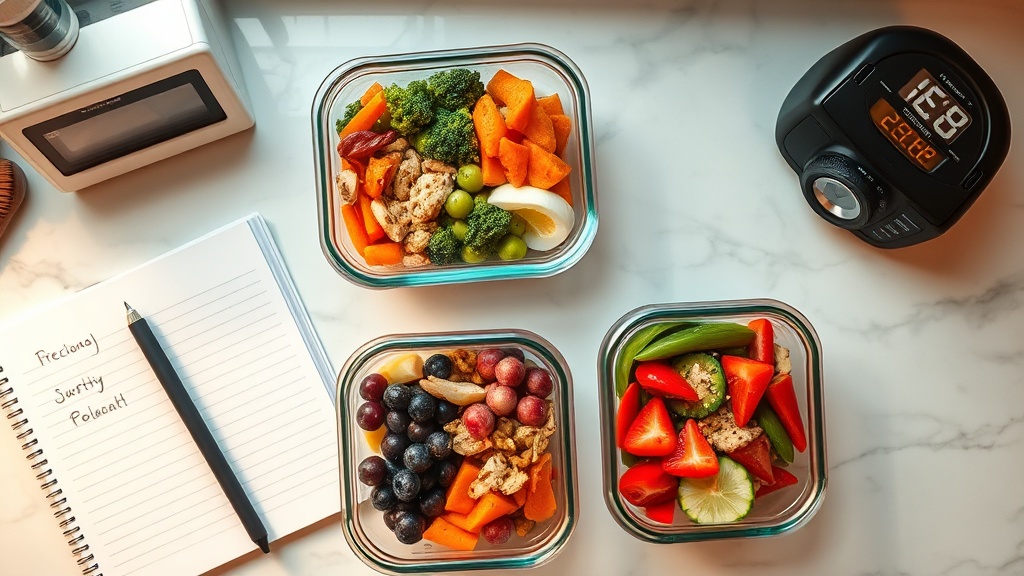
Step 1: Set your eating window to 1:00 p.m.–7:00 p.m. This is the exact window used in the Nature Medicine trial. Six hours. Outside this window, only water, black coffee, or plain tea (no calories). Don't overthink the start time — 1 p.m. was chosen to align with post-cortisol-peak insulin sensitivity and to be practically sustainable for working adults.
Step 2: Do not count calories. This is not a loophole — it's the protocol. The TRE group in the Varady trial was explicitly instructed not to track caloric intake. The spontaneous reduction in energy intake that comes from a compressed eating window appears sufficient. If you're adding calorie restriction on top, you're running a different protocol than what was tested.
Step 3: Prioritize protein and fiber in your first meal. The trial didn't prescribe macronutrient ratios, but given that lean mass was preserved across the TRE group, adequate protein intake matters. Aim for 25–30g protein at your 1 p.m. meal. This isn't optional if you want to protect lean mass — and for PCOS, lean mass drives the insulin sensitivity improvements you're after.
Step 4: Maintain the protocol for a minimum of 12 weeks before evaluating. The von Damm preprint showed metabolic changes at 90 days[4]. The Varady trial ran for 6 months. Don't expect meaningful hormonal shifts at week 3. (And yes, I've heard every objection to this — the "but I didn't see results in two weeks" crowd is mostly measuring the wrong things.)
Step 5: Track the right biomarkers. Request fasting insulin, HOMA-IR, free androgen index, and SHBG at baseline and at 3 and 6 months. Body weight alone won't tell you whether the hormonal benefits are manifesting. If your clinician only checks testosterone and weight, push for the full panel.
Step 6: Address sleep and stress independently. TRE is not a magic fix for PCOS if your cortisol is chronically elevated from 5 hours of sleep and unmanaged stress. The circadian alignment benefits of TRE are partially negated by circadian disruption elsewhere. This is a systems problem — don't isolate one variable and expect it to carry the whole load.
Related Video
What is time-restricted eating and how does it differ from intermittent fasting?#
Time-restricted eating is a specific form of intermittent fasting where you limit all daily food intake to a set window — typically 6 to 10 hours — every day. Unlike alternate-day fasting or 5:2 protocols, TRE doesn't involve full fasting days. The 6-hour window (1 p.m.–7 p.m.) used in the Varady Nature Medicine trial is more restrictive than the popular 16:8 pattern but produced clinically meaningful results without calorie counting.
Why might TRE be better than calorie restriction for women with PCOS specifically?#
The data shows TRE produces equivalent weight loss to calorie restriction but may offer additional hormonal benefits — specifically, a greater reduction in free androgen index (FAI). This likely relates to improved circadian insulin signaling rather than caloric deficit alone. That said, "better" depends on what you're optimizing for. If adherence is your bottleneck (and for most people, it is), not having to count calories is a significant practical advantage.
How long does it take for TRE to improve PCOS symptoms?#
Based on the available data, metabolic markers like HOMA-IR and fasting insulin may begin shifting within 8–12 weeks, while meaningful changes in body weight and hormonal markers like FAI appear to require 3–6 months of consistent adherence. The Varady trial measured outcomes at 6 months; the von Damm preprint at 90 days. Honestly, if you're checking for results weekly, you're creating unnecessary anxiety. Commit to 12 weeks minimum.
Who should avoid time-restricted eating?#
Women who are pregnant, breastfeeding, or have a history of eating disorders should not implement TRE without direct clinical supervision. Anyone on insulin or sulfonylureas should coordinate with their prescribing physician, as meal timing changes can affect medication pharmacokinetics. TRE is also not appropriate for adolescents without medical oversight — the Tan et al. case report in twins was conducted under clinical supervision for this reason[3].
What are the side effects of a 6-hour TRE protocol?#
The Varady trial reported no serious adverse events. The Chen et al. meta-analysis across 13 RCTs found only minor issues: transient hunger, occasional headaches, and mild irritability — all self-resolving within the first 1–2 weeks[6]. I'll be direct: the first 5 days are uncomfortable. After that, ghrelin timing resets and the hunger window shifts. Most people adapt faster than they expect.
VERDICT#
Score: 8/10
This is the strongest evidence we've had for TRE in PCOS — a well-designed three-arm RCT in Nature Medicine showing equivalent weight loss to calorie restriction, with a notable bonus: superior androgen reduction that calorie restriction alone didn't achieve. The sample size is still modest (n=76), and I'd want replication with longer follow-up and continuous metabolic monitoring before calling this definitive. But as a practical, low-friction dietary approach for women with PCOS who've struggled with calorie-counting fatigue? The evidence-to-effort ratio here is excellent. I'm not giving it a 9 because we still lack mechanistic clarity on the androgen effect, and the trial didn't measure long-term reproductive outcomes. But this moves TRE from "interesting idea" to "evidence-supported option" for PCOS management.
References
- 1.Varady K et al.. Time-restricted eating for body weight management in women with polycystic ovary syndrome: a randomized controlled trial. Nature Medicine (2026). ↩
- 3.Tan Z, Feng J, Li Y, Huang Q, Liao X, Luo D. Case Report: Time-restricted feeding improves metabolism in twins with polycystic ovary syndrome and insulin resistance. Frontiers in Adolescent Medicine (2025). ↩
- 4.von Damm I, Hernández-Ortega M, Dickter Sarfati C, von Son F. Beyond Hormones: The Efficacy of Time-Restricted Eating as an Alternative to Traditional Pharmacological Therapy for Polycystic Ovary Syndrome. medRxiv (2025). ↩
- 5.Corapi S et al.. 1916-LB: Time-Restricted Eating for the Management of Polycystic Ovary Syndrome—A Randomized Controlled Trial. Diabetes (2025). ↩
- 6.Chen S, Zhang X, Kortas J, Liu H. Effects of time-restricted eating on body composition and metabolic parameters in overweight and obese women: a systematic review and meta-analysis. Frontiers in Nutrition (2025). ↩
Tara Miren
Tara is warm but sharp. She will directly contradict popular nutrition narratives mid-article without building up to it: 'The 16:8 window isn't special. The mechanism doesn't care about that specific split.' She uses parenthetical asides like a real person thinking out loud: '(and yes, I've heard every objection to this — they're mostly wrong)'. She'll acknowledge when she changed her mind based on a paper: 'I used to recommend X. I don't anymore.'
View all articles →