PTSD Thalamocortical Circuit Deficits in Cognitive Restructuring

SNIPPET: A 2026 Nature Mental Health study using 7-Tesla fMRI reveals that in PTSD, the medial prefrontal cortex fails to adequately inhibit the mediodorsal thalamus during cognitive restructuring. This weakened top-down cortical control (posterior probability 0.95) predicted severity of negative post-traumatic cognitions about the world and others (r = 0.38, P = 0.006).
THE PROTOHUMAN PERSPECTIVE#
There's a question that haunts trauma neuroscience: why do some people stay trapped in negative thought loops after trauma while others, exposed to equivalent horror, eventually update their beliefs? The answer, it turns out, may live not in the cortex alone but in the conversation between cortex and thalamus — a relay station we've underestimated for decades.
This matters for anyone serious about cognitive performance optimization. The thalamus isn't just a passive switchboard. It's an active gatekeeper of prefrontal engagement, and when that gate malfunctions, the higher-order thinking we rely on for reappraisal, planning, and emotional regulation degrades. If you've ever wondered why meditation or cognitive-behavioral techniques feel effortless for some people and impossibly heavy for others, this circuit may be part of that story. The data here doesn't just illuminate PTSD — it reframes how we think about cognitive flexibility itself.
THE SCIENCE#
What Cognitive Restructuring Actually Requires From the Brain#
Cognitive restructuring is the clinical term for something deceptively simple: taking a negative thought ("the world is dangerous") and deliberately challenging it ("some places are unsafe, but I have agency"). It's a core component of cognitive processing therapy and trauma-focused CBT. But what does the brain actually do during this process?
The word "restructuring" is doing a lot of work here. I think we casually assume it's a prefrontal cortex affair — top-down reasoning overriding emotional reactivity. That framing isn't wrong exactly, but it's incomplete. The mediodorsal thalamus (MD thalamus) acts as a synchronizing hub for prefrontal networks, coordinating which cortical regions come online and when[1]. Think of it less as a relay and more as an orchestra conductor that the prefrontal cortex is supposed to modulate.
This study, published in Nature Mental Health in March 2026, used ultrahigh-field 7-Tesla functional MRI to examine this circuitry with unusual precision[1]. The 7T resolution matters — conventional 3T scanners struggle to reliably isolate thalamic subnuclei, which are small, deep, and easily blurred by neighboring structures.
The Study Design#
Seventy participants with PTSD and 66 trauma-exposed controls (people who experienced comparable trauma but didn't develop PTSD) completed a cognitive restructuring paradigm inside the scanner. Dynamic causal modeling (DCM) — a technique that estimates directed, effective connectivity rather than mere correlation — was applied to a final sample of 57 PTSD and 59 control participants[1].
The paradigm involved two conditions: challenge (actively restructuring a negative trauma-related cognition) versus repeat (simply restating the cognition without reappraisal). The contrast between these conditions isolates the neural work of restructuring itself.
The Key Finding: A Weakened Inhibitory Pathway#
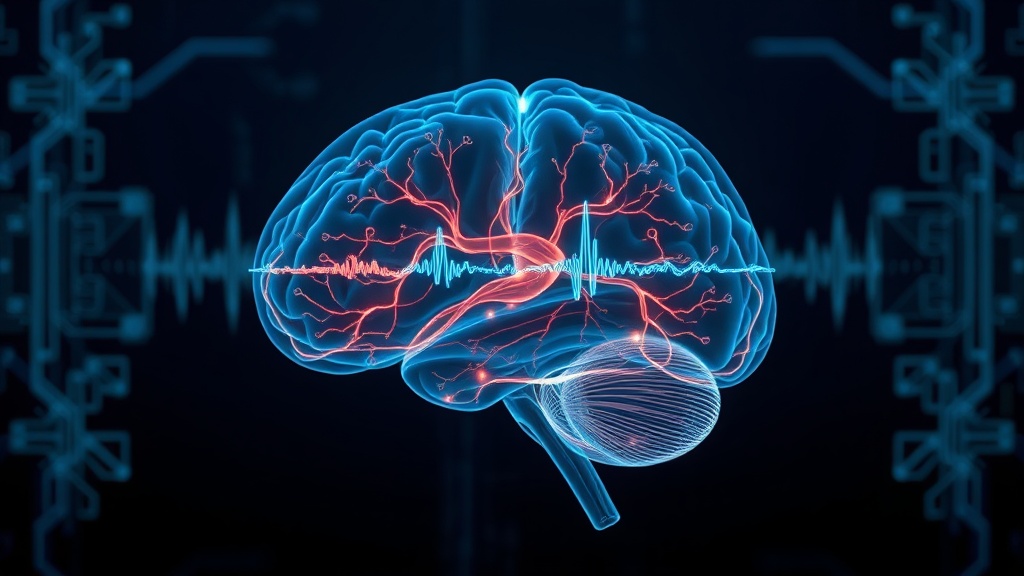
Here's where it gets interesting. In trauma-exposed controls, the medial prefrontal cortex (mPFC) exerted strong inhibitory influence over the mediodorsal thalamus during restructuring. This makes intuitive sense — the cortex is saying, essentially, "quiet down, I'm updating this belief."
In PTSD participants, that inhibitory pathway was significantly weaker (posterior probability of 0.95)[1]. The mPFC wasn't silencing the thalamus effectively. And this wasn't just a statistical abstraction: the modulatory strength of this specific pathway predicted how severe participants' negative cognitions were about the world and other people (r = 0.38, P = 0.006)[1].
An r of 0.38 isn't earth-shattering in isolation. It explains roughly 14% of the variance in post-traumatic cognitions. But here's what I find compelling: this is a single pathway in a single direction within a distributed network, measured during a specific cognitive task. The fact that it accounts for that much variance in symptom severity is, honestly, more than I'd expect.
What This Means Mechanistically#
The mediodorsal thalamus doesn't just passively receive cortical input. It participates in reverberant loops — cortex signals thalamus, thalamus signals back, and the resulting oscillation sustains working memory and flexible cognition. When the mPFC can't properly inhibit MD thalamic activity, those loops may become dysregulated, potentially sustaining threat-biased representations instead of allowing belief updating.
This connects to something from the attentional blink literature — different context, but the pattern holds. When thalamic gating goes awry, the system gets stuck processing one interpretation and can't flexibly shift to another.
But here's where I want to push back slightly. The study is cross-sectional. We're seeing a snapshot of connectivity differences between groups, not watching the pathway degrade over time. It's entirely possible that the weakened mPFC-to-thalamus inhibition is a consequence of chronic PTSD rather than a cause. Or a pre-existing vulnerability. The authors are careful about this, but the causality question remains open.
Circuit-Level Context: The Broader Framework#
A complementary review by Xin Yi and colleagues, published in Molecular Psychiatry in February 2026, provides important context[2]. Their circuit-informed framework for traumatic memory modulation emphasizes that PTSD persists because stress biases memory systems — broadening threat engrams while weakening context-appropriate inhibition and making extinction fragile.
Critically, they highlight the role of thalamic coordinators in hippocampal-prefrontal-amygdala pathways[2]. The thalamus isn't a footnote in their model; it's a central orchestrator of whether extinction learning consolidates or collapses. Their framework suggests that stabilizing extinction requires preferentially engaging these pathways through targeted training and sleep-based reactivation, and that reconsolidation windows can be leveraged for memory updating when paired with appropriate neuromodulation[2].
What strikes me is that both papers converge on the thalamus — one from a restructuring angle, the other from an extinction/reconsolidation angle. That convergence feels meaningful.
mPFC-to-MD Thalamus Inhibitory Connectivity During Cognitive Restructuring
COMPARISON TABLE#
| Method | Mechanism | Evidence Level | Cost | Accessibility |
|---|---|---|---|---|
| Cognitive Restructuring (standard CBT/CPT) | Prefrontal reappraisal of negative cognitions; engages mPFC-thalamic inhibitory pathways | Multiple RCTs; now neuroimaging-supported | $100–250/session | Widely available; therapist-dependent |
| 7T fMRI-guided connectivity assessment | Maps effective connectivity in thalamocortical circuits with subnuclear precision | Single study (n=116); novel methodology | $1,500–3,000/scan | Research settings only; ~50 7T scanners worldwide |
| Extinction-based exposure therapy | Engages hippocampal-prefrontal-amygdala pathways; thalamic coordination | Strong RCT evidence; high relapse rates | $100–250/session | Widely available |
| Reconsolidation-targeted interventions | Opens memory lability window via prediction error; pairs with neuromodulation | Preclinical + early human trials | Variable ($200–2,000+) | Experimental; limited access |
| rTMS to mPFC/dlPFC | Non-invasive stimulation to enhance prefrontal control over subcortical targets | Growing RCT evidence for PTSD | $200–400/session | Expanding; clinic-dependent |
THE PROTOCOL#
How to leverage these findings for optimizing cognitive restructuring — whether you're a clinician, a client, or someone interested in strengthening prefrontal-thalamic control:
1. Prioritize structured cognitive restructuring within therapy. If you're in treatment for PTSD or trauma-related symptoms, ensure your protocol includes explicit cognitive restructuring — not just exposure. The data suggests these engage partially distinct circuits[1]. Ask your therapist about cognitive processing therapy (CPT), which centers restructuring as a primary mechanism.
2. Target the specific content domain. The correlation with symptom severity was specific to cognitions about the world and others (r = 0.38, P = 0.006), not all post-traumatic cognitions equally[1]. In restructuring exercises, prioritize beliefs like "people can't be trusted" or "the world is entirely dangerous" — these appear most tightly linked to the thalamocortical deficit.
3. Consider adjunctive prefrontal engagement strategies. Based on current evidence, activities that strengthen top-down prefrontal control may support the restructuring circuit. This includes: mindfulness-based attention training (which recruits mPFC during non-reactive observation), working memory training, and HRV biofeedback (which has shown mPFC engagement in neuroimaging studies).
4. Optimize sleep for memory reconsolidation. Xin Yi et al.'s framework emphasizes sleep-based reactivation as critical for consolidating updated trauma memories[2]. After restructuring sessions, prioritize 7-9 hours of sleep, avoid alcohol (which disrupts REM-dependent consolidation), and consider morning therapy sessions to maximize the time between restructuring and the next sleep cycle.

5. Explore neuromodulation as an adjunct (with clinical guidance). Repetitive transcranial magnetic stimulation (rTMS) targeting the dorsolateral or medial prefrontal cortex is being investigated to enhance top-down control in PTSD. If standard therapy plateaus, discuss with your provider whether rTMS or transcranial direct current stimulation (tDCS) over prefrontal regions could supplement cognitive restructuring.
6. Track your cognitive shifts, not just emotional states. Most self-monitoring in trauma treatment focuses on distress ratings. Based on this data, I'd suggest also tracking your belief conviction — rate how strongly you hold specific negative cognitions weekly (0-100 scale). Changes in belief conviction may be a more direct proxy for the circuit this study identified.
7. Don't rush the process. Weakened mPFC-thalamic inhibition likely reflects entrenched neural patterns. Cognitive restructuring may need repetition — not because the technique is weak, but because the circuit needs repeated engagement to strengthen. Think of it as neuroplasticity under load: the pathway won't normalize in one session.
Related Video
What is the mediodorsal thalamus and why does it matter for PTSD?#
The mediodorsal thalamus is a thalamic subnucleus that serves as a key coordinator for higher-order prefrontal cortex activity. It's not just a passive relay — it actively synchronizes the cortical networks involved in flexible thinking, working memory, and belief updating. In PTSD, the prefrontal cortex appears unable to properly inhibit this region during cognitive restructuring, which may explain why negative trauma-related beliefs persist despite therapeutic effort[1].
How was this study different from previous PTSD neuroimaging research?#
Most prior PTSD imaging studies used standard 3-Tesla MRI and measured correlational connectivity (which brain regions activate together). This study used 7-Tesla ultrahigh-field fMRI — which provides substantially better spatial resolution for deep structures like the thalamus — combined with dynamic causal modeling, which estimates directed influence between regions[1]. That distinction matters: it tells us not just that regions co-activate, but that one region is failing to inhibit another.
Why can't people with PTSD simply "think their way out" of negative beliefs?#
This is a question I encounter constantly, and it often carries an implicit judgment. The data here offers a neurobiological answer: the circuit required for belief updating is functionally impaired in PTSD[1]. It's not a failure of willpower or intelligence. The mPFC-thalamic pathway that supports cognitive restructuring is measurably weaker, and the degree of weakness predicts how entrenched negative cognitions are. Understanding this should shift the conversation from "try harder" to "this circuit needs targeted rehabilitation."
What does cognitive restructuring actually feel like during therapy?#
Honestly, it often feels frustrating — and that's worth naming. You're asked to take a thought you deeply believe ("the world is dangerous") and generate alternative perspectives while your emotional system screams that the original thought is true. The data suggests this friction has a neural correlate: the mPFC is working against a thalamus that isn't quieting down properly. When restructuring starts to "click," patients often describe it not as sudden insight but as a gradual loosening — the negative thought feels less absolute, less load-bearing.
How might these findings change PTSD treatment in the future?#
The most immediate implication is the potential for circuit-specific biomarkers. If mPFC-thalamic connectivity during restructuring predicts treatment response, 7T fMRI could eventually guide clinical decisions — identifying patients who need adjunctive neuromodulation versus those likely to respond to standard CBT alone. Longer term, the Yi et al. framework suggests combining restructuring with reconsolidation-based interventions and sleep-targeted protocols for more durable outcomes[2].
VERDICT#
Score: 7.5/10
This is a well-designed study that asks the right question and uses the right tools to answer it. The 7T fMRI with dynamic causal modeling is a genuine methodological advance for parsing thalamic circuitry in PTSD, and the specificity of the mPFC-thalamic finding — linking one directed pathway to one symptom domain — is more precise than most neuroimaging work in this space. I'm less convinced by the clinical extrapolations one might draw at this stage: n = 116 is respectable but not large, the study is cross-sectional, and an r of 0.38 leaves substantial unexplained variance. The honest answer is we don't yet know if strengthening this pathway would reduce symptoms, only that its weakness tracks with them. Still, this is the kind of mechanistic specificity that trauma neuroscience has needed. The thalamus has been the forgotten node in the PTSD circuit story, and this study makes a credible case for putting it back on the map.
References
- 1.Agathosj et al.. Cognitive restructuring and thalamocortical circuit alterations in post-traumatic stress disorder. Nature Mental Health (2026). ↩
- 2.Xin Yi et al.. Circuit-informed modulation of traumatic memory in PTSD: integrating extinction, suppression, and reconsolidation. Molecular Psychiatry (2026). ↩
- 3.Ehlers A, Clark DM. A cognitive model of posttraumatic stress disorder. Behaviour Research and Therapy (2000). ↩
Fen Adler
Fen writes with psychological nuance and a slightly meandering quality that feels human. He'll start pursuing one idea, realize it connects to something else, and follow it briefly before returning: 'This reminds me of something from the attentional blink literature — different context, but the pattern holds.' He's interested in the experience, not just the mechanism, which means he'll occasionally ask: 'What does this actually feel like?' when discussing neurological effects.
View all articles →