Nanoliposuction Hydrogel Recycles Senescent Cell Lipids for OA

THE PROTOHUMAN PERSPECTIVE#
For decades, the anti-aging field operated under a simple directive: find senescent cells, kill them. Senolytics — drugs like dasatinib plus quercetin — became the shining instruments of that philosophy. But the data has been telling us something more nuanced, and we've been slow to listen.
What if senescent cells aren't just garbage to be cleared, but raw material to be recycled?
The research published today in Nature Communications proposes exactly that. Instead of destroying senescent cells wholesale, a Chinese research team has engineered a hydrogel system that siphons lipids from these cells and repurposes them as joint lubricants. It's an approach that respects something I think we forget too easily in longevity science: biological systems evolved to waste nothing. Every senescent cell sitting in your cartilage is a metabolic liability and a reservoir of phospholipids your joints desperately need. The question was always whether we could separate those two identities. Now, it appears we can.
This matters on a decade-level timescale. Osteoarthritis affects over 500 million people globally, and current interventions — corticosteroid injections, viscosupplementation, eventual joint replacement — treat symptoms while ignoring the senescent cell burden driving cartilage destruction.
THE SCIENCE#
Senescent Cells: The Lipid Problem Nobody Recycled#
Senescent cells (SnCs) are cells that have permanently exited the cell cycle but refuse to die. They accumulate with age, secreting a toxic cocktail of inflammatory cytokines, proteases, and growth factors collectively known as the senescence-associated secretory phenotype (SASP)[1]. In osteoarthritic joints, SnCs are particularly destructive — they degrade cartilage matrix, promote chronic inflammation, and paradoxically, they hoard lipids.
This lipid accumulation is not incidental. It's a defining metabolic signature.
Zeng et al. established in their 2024 review that lipid dysregulation is universal across senescent cell types, with increased lipid droplet formation, altered membrane composition, and disrupted fatty acid oxidation pathways[1]. The lipids accumulate because senescent cells upregulate lipogenesis while simultaneously downregulating beta-oxidation — they're producing fat they can't burn.
But here's where it gets complicated. Those same lipids — particularly phosphatidylcholines and phosphatidylethanolamines — are precisely what articular cartilage needs for boundary lubrication. Healthy cartilage surfaces are coated in phospholipid layers that reduce friction coefficients to levels no synthetic material can match[1]. As osteoarthritis progresses, these lubricating layers degrade. The cruel irony: senescent cells in OA joints are hoarding the very molecules that could protect the cartilage they're destroying.
The Nanoliposuction Hydrogel: Engineering Waste Recycling#
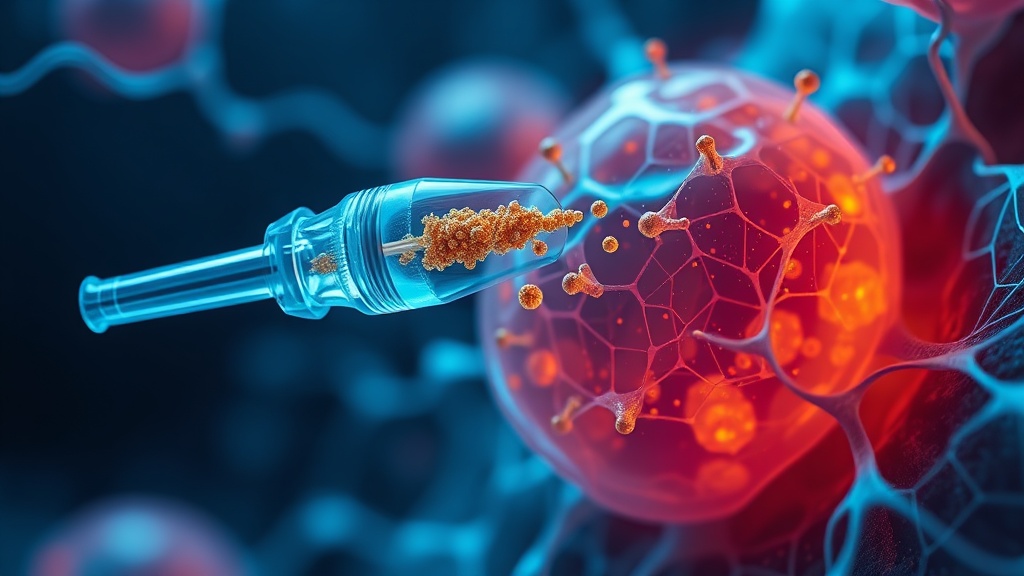
Ji, He, Cai, and colleagues at their research institution developed what they term an injectable "nanoliposuction" hydrogel platform — a system designed to extract lipids from senescent cells and redistribute them as functional lubricants[1].
The concept is elegant in its biological logic. Rather than deploying senolytic agents to kill SnCs (which risks collateral damage to healthy tissue and triggers inflammatory debris clearance), the hydrogel performs targeted lipid extraction. The senescent cells are effectively liposuctioned at the nanoscale.
The system exploits the fact that senescent cell membranes exhibit compromised bilayer asymmetry — a feature independently confirmed by Moral-Sanz et al. in their Nature Aging study on senotoxins[3]. Normal cells maintain strict phospholipid asymmetry across their plasma membrane, with phosphatidylserine confined to the inner leaflet. Senescent cells lose this organization, exposing lipid species on their outer surface that become accessible targets.
The p53–Lipid Recycling Axis: Why Senescent Cells Are Lipid Factories#
To understand why this approach works, you need to understand why senescent cells accumulate lipids in the first place. Yashinskie et al., publishing in Nature Cell Biology in January 2026, provided the mechanistic answer[4].
p53 — the tumor suppressor transcription factor — actively drives phospholipid headgroup recycling during senescence. When p53 activates (as it does during the senescence program), it upregulates autophagy and lysosomal catabolism genes that enable membrane turnover. The cell increases its supply of phosphoethanolamine, funneling it through the Kennedy pathway for de novo phosphatidylethanolamine synthesis[4].
This isn't a bug. It's a feature. Senescent cells need more membrane phospholipids because they're dramatically larger than normal cells — often 3-5 times the volume — and they must maintain membrane integrity despite not dividing. p53 solves this by recycling lipid headgroups from old membranes to build new ones.
The vulnerability this creates is specific and exploitable. CRISPR-Cas9 genetic screens revealed that p53-activated cells preferentially depend on genes involved in lipid metabolism and lysosomal function[4]. Disrupt phosphoethanolamine conversion to phosphatidylethanolamine, and senescent cells undergo dramatic organelle remodeling and fitness collapse — while normal cells tolerate the same disruption without issue.
The nanoliposuction hydrogel exploits this dependency from the outside in. By physically extracting the lipids that senescent cells desperately need to maintain their bloated membranes, the system compromises SnC fitness without requiring toxic senolytic drugs.
Senotoxins and the Lipid Membrane as Therapeutic Target#
Independent confirmation of lipid-based senescent cell targeting comes from Moral-Sanz et al.'s work on sticholysin I (StnI), a pore-forming toxin from the Caribbean sea anemone Stichodactyla helianthus[3].
StnI and its engineered variant StnIG selectively kill senescent cells by exploiting their altered membrane lipid composition — specifically the ratio of sphingomyelin, phosphatidylcholine, and cholesterol[3]. The toxin triggers sodium and calcium influx and sustained potassium efflux in senescent cells, activating calcium-dependent potassium channels and inducing death through both apoptosis and pyroptosis.
In mouse models, StnIG synergized with senescence-inducing chemotherapy to drive tumor remission[3]. The selectivity index was notable — senescent cells were far more susceptible than proliferating cells, precisely because of their distinctive lipidome.
I'll be direct: the senotoxin data impresses me more on the cancer side than the longevity side. Injecting engineered sea anemone toxins into human joints is not where this is heading. But the principle it validates — that senescent cell membranes are lipid-distinct enough to serve as selective targets — is exactly what makes the nanoliposuction approach credible.
Senotherapy Approaches: Key Differentiators
COMPARISON TABLE#
| Method | Mechanism | Evidence Level | Cost | Accessibility |
|---|---|---|---|---|
| Nanoliposuction Hydrogel | Lipid extraction from SnCs + redistribution as lubricant | Preclinical (animal models) | Unknown (experimental) | Research-only |
| Dasatinib + Quercetin | BCL-2/PI3K inhibition, broad senolysis | Phase II human trials | ~$50–150/month (off-label) | Available off-label |
| Navitoclax (ABT-263) | BCL-2/BCL-xL inhibition | Preclinical + early clinical | High (oncology drug) | Clinical trials only |
| StnIG Senotoxin | Lipid-specific pore formation in SnC membranes | Preclinical (mouse tumors) | Unknown | Research-only |
| CAR-T Anti-Senescent | uPAR-targeted immune cell engineering | Preclinical | Very high ($100K+ estimated) | Research-only |
| Viscosupplementation (HA) | Hyaluronic acid joint lubrication | Established clinical use | $300–800/injection | Widely available |
THE PROTOCOL#
The nanoliposuction hydrogel is not available for clinical use. Optimal dosing in humans is not yet established. However, based on the converging data from these studies, here is a protocol framework for individuals looking to address senescent cell lipid burden through currently accessible interventions:
Step 1: Establish baseline joint and senescence status. Request inflammatory biomarker panels including high-sensitivity CRP, IL-6, and if available through specialized clinics, circulating p16^INK4a expression levels. These provide a rough proxy for systemic senescent cell burden.
Step 2: Implement a cyclic senolytic protocol (if appropriate and physician-supervised). Based on current evidence, the dasatinib (100mg) plus quercetin (1000mg) combination taken for 2 consecutive days per month has shown preliminary efficacy in reducing senescent cell markers in human trials, as noted by Hickson et al.[2]. This is not a daily supplement — it is an intermittent clearance protocol.
Step 3: Support endogenous lipid recycling pathways. p53-dependent lipid recycling relies on functional autophagy and lysosomal catabolism[4]. Time-restricted eating (16:8 or 18:6 windows) activates autophagy pathways. Spermidine supplementation (1-2mg/day from wheat germ extract) may further support autophagic flux, though human dosing data remains limited.
Step 4: Optimize phospholipid intake for joint lubrication. Since the nanoliposuction approach repurposes SnC lipids as boundary lubricants, you can support cartilage lubrication directly through dietary phospholipids. Krill oil (1-2g/day) provides phosphatidylcholine in bioavailable form. Egg yolks are a dense source of phosphatidylethanolamine.
Step 5: Maintain joint-specific phospholipid boundary layers. For those with existing OA symptoms, undenatured type II collagen (UC-II, 40mg/day) combined with omega-3 supplementation may support cartilage matrix integrity while the field awaits translational development of lipid-recycling hydrogels.
Step 6: Monitor and adjust quarterly. Repeat biomarker panels every 3 months. Track functional outcomes — joint range of motion, pain scores, grip strength — alongside molecular markers. If you choose to trial a senolytic protocol, the honest answer is that long-term human safety data beyond 2 years does not yet exist.
Related Video
What is the nanoliposuction hydrogel and how does it work?#
The nanoliposuction hydrogel is an injectable biomaterial platform developed by Ji et al. that extracts accumulated lipids from senescent cells in joint tissue and repurposes them as boundary lubricants for cartilage surfaces. It targets the universal lipid accumulation signature of senescent cells rather than killing them outright. This is currently a preclinical technology — not available for human use.
Why do senescent cells accumulate so many lipids?#
Senescent cells are dramatically larger than normal cells and must maintain membrane integrity without dividing. The transcription factor p53 drives lipid headgroup recycling through autophagy and lysosomal pathways to meet this demand, as shown by Yashinskie et al. in Nature Cell Biology[4]. They also upregulate lipogenesis while downregulating fatty acid oxidation, creating a net lipid surplus that forms visible lipid droplets.
How is this different from taking senolytics like dasatinib and quercetin?#
Traditional senolytics kill senescent cells by inhibiting their anti-apoptotic survival pathways. The nanoliposuction approach doesn't kill SnCs — it extracts their lipid cargo and converts it into something useful. This avoids the inflammatory debris generated by senolysis and the systemic side effects like thrombocytopenia seen with agents such as navitoclax[2]. The trade-off is that it's local (injected into joints) rather than systemic.
Who would benefit most from this technology if it reaches clinical use?#
Patients with early-to-moderate osteoarthritis would be the primary candidates, particularly those who have failed conservative management but aren't yet candidates for joint replacement. The dual mechanism — reducing senescent cell pathology while simultaneously improving joint lubrication — addresses two major OA drivers simultaneously, which no current therapy does.
When might lipid-recycling senotherapy become available to patients?#
Based on the current stage of research (preclinical, published March 2026), I'd estimate a minimum of 5-7 years before any human clinical trials produce actionable data — and that's optimistic. The hydrogel platform needs toxicology studies, manufacturing standardization, and Phase I safety trials before efficacy can even be assessed in humans. I'd want to see this replicated by independent groups before getting too attached to the timeline.
VERDICT#
Score: 7.5/10
The data moved me. Not because it's ready for clinical translation — it isn't — but because it represents a genuine philosophical shift in how we think about senescent cells. The field has been locked in a kill-or-be-killed mentality since the first senolytic papers in 2015, and the limitations of that approach are becoming undeniable: off-target toxicity, thrombocytopenia, resistance mechanisms, and the inconvenient reality that some senescent cells serve necessary functions in wound healing and tumor suppression.
The nanoliposuction concept — waste recycling instead of waste disposal — is the kind of thinking that could redefine the next decade of senotherapy. The supporting evidence from Yashinskie et al. on p53-driven lipid recycling and Moral-Sanz et al. on lipid membrane specificity gives this more mechanistic depth than most preclinical novelties deserve.
The design limitations are real, though. This is a local injection for OA joints, not a systemic anti-aging intervention. The leap from "works in animal models" to "works in human joints" has a graveyard of failed therapies behind it. And the team hasn't published long-term durability data — does the hydrogel need repeated injections? How often?
Still. This is the kind of research that changes how I think about the problem. That's worth something.
References
- 1.Ji X, He X, Cai H, Tang P, Zhou H, Wang J, Wu Y, Zhou J, Lin Z. Recycling senescent cell lipids for targeted senotherapy. Nature Communications (2026). ↩
- 2.Lelarge V, et al.. Emerging strategies in senotherapeutics: from broad-spectrum senolysis to precision reprogramming. npj Aging (2026). ↩
- 3.Moral-Sanz J, Fernández-Carrasco I, Ramponi V, Garrido A, Karbat I, Cabezas-Sainz P, Rivera-de-Torre E, Elsallabi O, Martín-Hernández R, López-Aceituno JL, Price NL, Sanchez L, Fernández-Rojo MA. Senotoxins target senescence via lipid binding specificity, ion imbalance and lipidome remodeling. Nature Aging (2026). ↩
- 4.Yashinskie JJ, Zhu X, Finley LWS. p53 increases phospholipid headgroup scavenging in senescence. Nature Cell Biology (2026). ↩
Orren Falk
Orren writes with the seriousness of someone who thinks about their own mortality every day and has made peace with it. He takes the long view, which means he's less excited than others about marginal gains and more focused on whether something moves the needle on a decade-level timescale. He'll admit when a study impresses him: 'This one actually moved me.' He uses 'the data' as a character in his writing — it speaks, it tells him things, it sometimes disappoints him.
View all articles →