Cytochrome C Oxidase Photon Absorption: PBM Mechanism Explained

THE PROTOHUMAN PERSPECTIVE#
We spend our lives bathed in light, yet most of us treat it as scenery. The emerging science of photobiomodulation forces a harder question: what if specific wavelengths of light are metabolic inputs as fundamental as oxygen or glucose?
Cytochrome c oxidase — Complex IV of the mitochondrial electron transport chain — is a photoacceptor. It absorbs red and near-infrared photons, and when it does, mitochondrial efficiency shifts. ATP output increases. Nitric oxide dissociates from the enzyme's binding site, unclogging the very machinery that powers every cell in your body.
For anyone interested in human performance optimization, this isn't peripheral science. This is the metabolic lever. Every age-related decline in vision, cognition, and tissue repair traces back, at least in part, to mitochondrial ATP production falling off. If targeted light exposure can restore even a fraction of that output, we're looking at one of the most accessible interventions in the longevity toolkit — no pills, no injections, just photons delivered at the right wavelength, the right dose, and the right time.
The catch, though. Most consumer devices get the parameters wrong.
THE SCIENCE#
What Cytochrome C Oxidase Actually Does — And Why Photons Matter#
Cytochrome c oxidase (CCO) is the terminal enzyme in the mitochondrial electron transport chain. It catalyzes the final transfer of electrons to molecular oxygen, producing water and driving the proton gradient that ATP synthase uses to generate adenosine triphosphate. Without functional CCO, mitochondrial energy conversion stalls.
Here's the part that changes the game for photobiomodulation: CCO contains two copper centers and two heme groups that absorb photons in the red and near-infrared spectrum. The absorption peaks cluster around 635, 810, 980, and 1064 nm[6]. Complex III also responds at 810, 980, and 1064 nm, and Complex I at 1064 nm — but CCO remains the primary chromophore driving photobiomodulation effects[6].
Under normal cellular conditions, nitric oxide (NO) binds non-covalently to the CuB site of CCO, inhibiting its activity. When photons at appropriate wavelengths strike the enzyme, they photodissociate this NO, restoring CCO function, elevating mitochondrial membrane potential (ΔΨm), and increasing ATP output[4]. This is not speculation. It is the most well-characterized mechanism in the photobiomodulation literature.
The 810 nm Sweet Spot: Thermodynamic Efficiency of Energy Conversion#
A 2024 study published in Scientific Reports by researchers using isolated bovine liver mitochondria provided the first thermodynamic analysis of photobiomodulation as an energy conversion process[6]. Using an 810 nm laser diode, they irradiated isolated mitochondria and measured the excess biochemical power density produced at regular intervals post-exposure.
The significance here is methodological. By working with isolated mitochondria rather than whole cells, the team eliminated confounding variables — no nucleus, no membrane receptors, no secondary signaling cascades. Just mitochondria, photons, and measurable energy output. The electromagnetic field and energetic quantities were computed for the stimulated organelles, and the measurements confirmed that 810 nm irradiation produces a quantifiable excess of biochemical energy beyond baseline mitochondrial output[6].
I want to be clear: this study establishes that the energy conversion is real and measurable at the organelle level. It does not tell us what the efficiency numbers look like in a living human cell, where the environment is vastly more complex.
TRPV1: The Second Pathway Nobody Talks About Enough#
Tong et al. (2025) published work in Scientific Reports that shifts the conversation beyond CCO alone[4]. Working with meniscus-derived stem cells (MeSCs), they tested photobiomodulation across four wavelengths (400–405, 500–505, 700–710, and 1064 nm) at energy densities of 3, 15, 30, and 60 J/cm².
Their findings: PBM increased intracellular calcium (Ca²⁺), CCO activity, NO concentrations, mitochondrial membrane potential, and cell proliferation in a dose-dependent manner. But here's the critical finding — blocking the TRPV1 channel (a transient receptor potential cation channel) abolished the calcium and ROS changes and prevented the associated proliferative effects[4].
This establishes a TRPV1-Ca²⁺-ROS signaling axis as a parallel mechanism to the classical CCO photodissociation pathway. Wavelength matters. Irradiance matters. But so does the ion channel environment of the target tissue.
Biophotons: Cells Emit Light Too — And PBM Changes the Signal#
Hoh Kam et al. (2025) investigated something most people outside photobiology haven't encountered: biophotons[2]. These are ultra-weak photon emissions generated by living cells — in the range of 2 to 200 photons/s/cm², undetectable by the naked eye.
Using Neuro-2a cells and astrocytes, they measured biophoton emissions under healthy conditions (~12 photons/s), under toxic stress (sodium troclosene and rotenone), and after red/near-infrared light treatment[2]. Healthy cells emitted biophotons at low, stable intensities. Sodium troclosene stress increased emissions markedly, while rotenone — a Complex I inhibitor — had a far more limited impact. R-NIr treatment could influence these emission patterns, particularly under stress conditions[2].
The two main organelles involved in biophoton production are mitochondria and microtubules, with ROS-related metabolic reactions being the primary biophoton source[2]. The photoacceptors involved include flavinic and pyridinic rings, cytochrome c oxidase, interfacial water, DNA, lipids, and aromatic amino acids.
The problem with this area of research: it's still largely descriptive. We can measure changes in biophoton emissions, but the functional significance — whether biophotons serve as intercellular communication signals or are simply metabolic exhaust — remains to be determined.
Sunlight Penetrates the Human Body: The Jeffery Findings#
Perhaps the most striking study in this collection comes from Jeffery et al. (2025), published in Scientific Reports with over 144,000 accesses[5]. They demonstrated that infrared wavelengths from sunlight can be measured after passing through the human thorax. Not scattered. Not theoretical. Measured.
Long wavelength red light (approximately 660–1000 nm) penetrates biological tissue deeply enough to reach internal organs. The study showed improved visual function measured 24 hours later — even in subjects where light was blocked from the eyes[5]. This is a systemic effect, not a local one.
The implications are significant. Sunlight's longer wavelengths may reach key organs even through clothing, promoting mitochondrial function via absorption by the copper-heme center in cytochrome c oxidase[5]. The outer retina — which contains more mitochondria than any other tissue — showed particular sensitivity to this intervention.
I'm less convinced this translates cleanly to therapeutic dosing recommendations. Sunlight is polychromatic, and the dose reaching deep tissues is highly variable depending on body composition, skin pigmentation, and clothing. But the finding that systemic effects occur from regional exposure is genuinely important.
CCO Absorption Peaks Across Mitochondrial Complexes
COMPARISON TABLE#
| Method | Mechanism | Evidence Level | Cost | Accessibility |
|---|---|---|---|---|
| 810 nm PBM (LED panels) | CCO photodissociation of NO, TRPV1 activation, ΔΨm increase | Multiple in vitro studies, emerging human trials | $150–$1,500 (consumer devices) | High — home use devices available |
| 670 nm Red Light | CCO absorption, ATP production boost, retinal mitochondria targeting | Replicated human RCTs (vision improvement) | $50–$400 | High |
| 1064 nm NIR | Activates Complexes I, III, IV; deepest tissue penetration | Preclinical + early human data | $300–$3,000 (clinical-grade lasers) | Moderate — some consumer devices |
| Sunlight Exposure (660–1000 nm) | Polychromatic CCO activation, systemic mitochondrial effect | Human study (Jeffery et al. 2025) | Free | Universal — weather/location dependent |
| NAD+ Precursors (NMN/NR) | Upstream mitochondrial cofactor replenishment | Multiple human RCTs | $30–$100/month | High |
| CoQ10 Supplementation | Electron carrier in Complex III → IV transfer | Well-established human data | $15–$50/month | High |
THE PROTOCOL#
How to apply photobiomodulation targeting cytochrome c oxidase — based on current evidence:
Step 1: Select the Right Wavelength. Prioritize devices emitting at 810 nm (near-infrared) or 670 nm (visible red). These are the two best-characterized wavelengths for CCO activation. Avoid broad-spectrum "red light" panels that don't specify peak wavelength within ±10 nm. If the manufacturer doesn't publish spectral data, walk away.
Step 2: Verify Irradiance at the Treatment Surface. Target 10–50 mW/cm² at the skin surface for most applications. Below 10 mW/cm², tissue penetration is insufficient for deep targets. Above 100 mW/cm², you risk biphasic dose response — the Arndt-Schulz curve, where excessive energy suppresses the very pathways you're trying to activate. Use a solar power meter or the manufacturer's irradiance data measured at specified distances.
Step 3: Calculate Your Energy Density (Fluence). Based on Tong et al. (2025), effective energy densities in cell studies range from 3 to 30 J/cm²[4]. For a 50 mW/cm² device, that translates to 60–600 seconds of exposure (1–10 minutes). Start at 3–4 J/cm² and titrate upward over weeks. The 60 J/cm² dose showed effects in cell culture but may not translate directly to human tissue dosing — be conservative.
Step 4: Time Your Sessions. Morning sessions (within 2 hours of waking) align with peak mitochondrial biogenesis signaling. Jeffery et al. (2025) showed visual improvements persisting 24 hours post-exposure[5], suggesting daily or every-other-day dosing is sufficient. Do not exceed one session per target area per day.
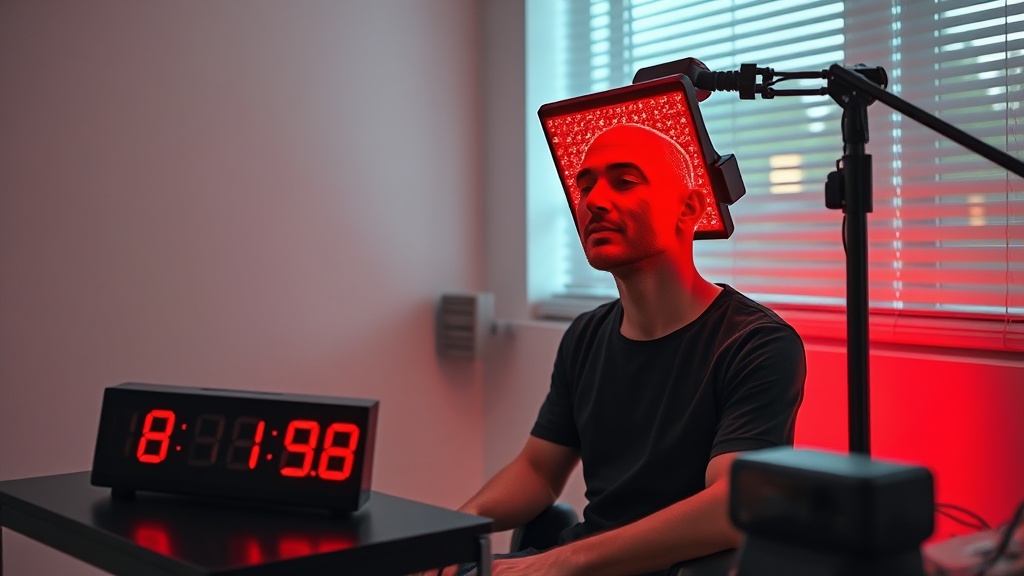
Step 5: Target Specific Tissue Areas. For cognitive and visual targets, expose the forehead and periorbital area (temples). For systemic effects, the Jeffery findings suggest that even torso exposure to long wavelengths can produce measurable outcomes[5]. For joint and musculoskeletal applications (relevant to the Tong et al. MeSC data), apply directly over the affected area at close range.
Step 6: Track and Adjust. Measure what you can. HRV (heart rate variability) can serve as a proxy for mitochondrial and autonomic function. Visual contrast sensitivity testing is free and repeatable if targeting retinal mitochondria. If you notice no change after 4 weeks of consistent use, increase energy density by 25% or reassess device output.
Step 7: Combine with Mitochondrial Support (Optional). PBM targets the electron transport chain downstream. Supporting upstream inputs — adequate CoQ10, NAD+ precursor supplementation (NMN 250–500 mg/day), and magnesium — may amplify effects. This is logical but not yet validated in combined-intervention trials.
Related Video
What is cytochrome c oxidase and why does it absorb light?#
Cytochrome c oxidase is the fourth and final enzyme complex in the mitochondrial electron transport chain. It contains copper centers and heme groups that naturally absorb photons in the red and near-infrared spectrum (635–1064 nm). This absorption is not a therapeutic invention — it's an intrinsic property of the enzyme's metal cofactors. PBM exploits this by delivering photons at those specific wavelengths to modulate enzyme activity.
How does photobiomodulation increase ATP production?#
The primary mechanism involves photodissociation of nitric oxide from the CuB binding site on cytochrome c oxidase[4][6]. When NO is bound, it inhibits the enzyme and slows electron transport. Photons at 810 nm or 670 nm knock NO loose, restoring CCO activity, increasing mitochondrial membrane potential, and driving more ATP synthesis through the proton gradient. A secondary pathway involves TRPV1 channel activation and calcium signaling[4].
Why does wavelength matter so much in photobiomodulation?#
Different mitochondrial complexes absorb at different wavelengths. Complex IV (CCO) responds to 635, 810, 980, and 1064 nm. Complex III responds at 810, 980, and 1064 nm. Complex I only at 1064 nm[6]. Using the wrong wavelength means photons pass through without interacting with the target chromophore. A "red light" device at 620 nm hits none of these peaks optimally. Precision matters — and most consumer devices don't provide it.
When is the best time to use red or near-infrared light therapy?#
Morning sessions appear to align best with circadian mitochondrial biogenesis cycles, though this is not firmly established in PBM-specific trials. Jeffery et al. (2025) showed effects lasting at least 24 hours after a single exposure[5], suggesting that daily or every-other-day protocols are reasonable. Avoid late evening sessions if using visible red wavelengths, as they may interfere with melatonin onset in sensitive individuals.
Who should avoid photobiomodulation?#
Individuals on photosensitizing medications (tetracyclines, certain chemotherapeutics, retinoids) should consult a physician before use. Those with active retinal conditions should avoid direct ocular exposure without clinical supervision. Honestly, the contraindication data is thin — most safety profiles come from the absence of reported adverse events rather than rigorous safety trials. That's not the same thing as proven safety.
VERDICT#
7.5 / 10
The mechanism is real. Cytochrome c oxidase absorbs near-infrared photons, NO dissociates, mitochondrial membrane potential increases, and ATP output rises. Multiple independent labs have confirmed this at the cellular and organelle level. The Tong et al. TRPV1 finding adds a genuine second pathway that deserves more attention.
But — and this is where I pull back — almost all of this data is preclinical. Cell cultures. Isolated mitochondria. Animal models. The Jeffery sunlight study is the closest thing to a human proof-of-concept, and even that has limitations in translating to therapeutic dosing. The consumer device market has outrun the science by years, selling specific protocols that the evidence doesn't yet support with precision.
The fundamentals are strong. The translation gap is real. Use it, but know what you're standing on.
References
- 1.Author(s) not listed. Long-Term Photobiomodulation of Cellular and Mitochondrial Activities in IMR-32 Cells Using an 810 nm Light-Emitting Diode. IEEE Journals (2025). ↩
- 2.Hoh Kam J, Clément R, Cantat-Moltrecht T, Billères M, Mitrofanis J. Red and near-infrared light treatment can change the intensity of biophoton emissions in cell culture. Scientific Reports (2025). ↩
- 4.Tong J, Wu X, Wang Z, Li X, Yu Y, Zhang Z, Zheng Z, Huang T, Ma Z. Photobiomodulation stimulates mitochondrial function and cell proliferation in meniscus-derived stem cells (MeSCs) via activation of TRPV1 channel. Scientific Reports (2025). ↩
- 5.Jeffery G, Fosbury R, Barrett E, Hogg C, Rodriguez Carmona M, Powner MB. Longer wavelengths in sunlight pass through the human body and have a systemic impact which improves vision. Scientific Reports (2025). ↩
- 6.Author(s) not listed. Photobiomodulation on isolated mitochondria at 810 nm: first results on the efficiency of the energy conversion process. Scientific Reports (2024). ↩
Sova Reld
Sova writes with focused intensity and low tolerance for vague claims. She came to photobiomodulation through personal experimentation and is irritated by both true believers and reflexive skeptics. Her writing has edge: 'The wellness market has done more damage to this field than the skeptics ever could.' She's extremely precise about parameters — wavelength, irradiance, duration — and will tell you when a study used inadequate dosing without apology.
View all articles →