Circuit-Targeted TMS Separates Anxiety and Depression Treatment

SNIPPET: Circuit-targeted transcranial magnetic stimulation (TMS) can differentially treat anxiety and depression symptoms by stimulating distinct brain circuits. A randomized trial found that anxiosomatic dorsomedial targeting improved anxiety scores 58% versus 36% with standard targeting (p = 0.0301), while both approaches reduced depression equally — opening the door to symptom-specific precision psychiatry.
The ProtoHuman Perspective#
For decades, we've treated depression and anxiety as if the brain runs on a single dial. Turn it up, turn it down. TMS has been one of the better tools in that limited toolbox — but it's been aimed imprecisely, like adjusting the thermostat for the whole house when only one room is cold.
What this trial out of Harvard/Brigham and Women's represents is something different: the beginning of circuit-level psychiatric targeting. Not "stimulate the left prefrontal cortex and hope for the best," but "identify which symptom cluster dominates, then hit the corresponding network." For anyone optimizing cognitive and emotional performance, this matters enormously. The distinction between feeling flat and unmotivated (dysphoric) versus physically anxious and somatically wound up (anxiosomatic) is one most people recognize in their own experience — but until now, clinical neurostimulation hasn't respected that difference. This is precision psychiatry moving from theory into randomized evidence, and the implications extend well beyond clinical depression into how we think about modulating emotional states at the network level.
The Science#
What Circuit-Targeted TMS Actually Means#
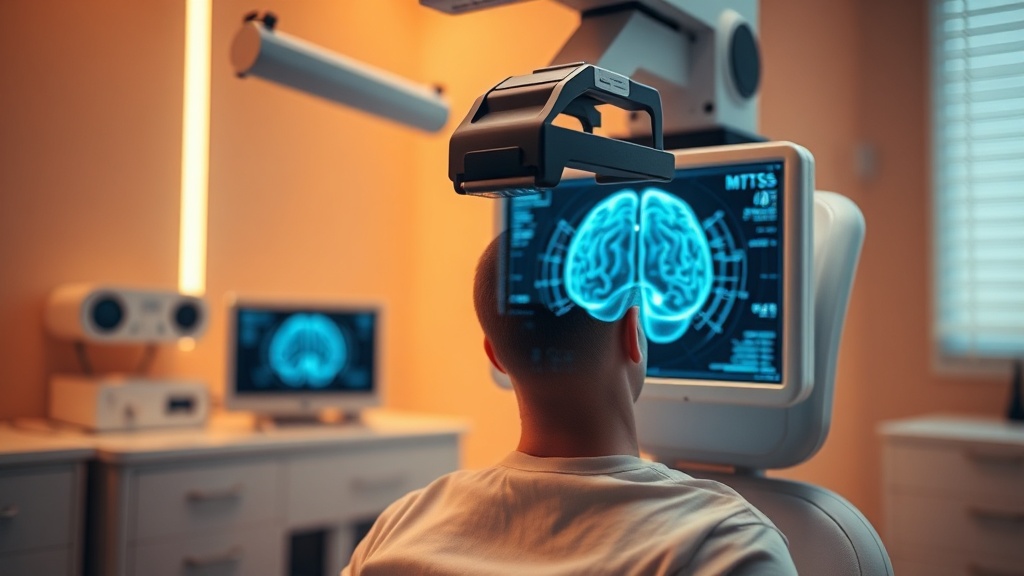
Transcranial magnetic stimulation is a non-invasive neuromodulation technique that uses magnetic pulses to alter neural activity in specific brain regions. It's FDA-cleared for major depressive disorder and has been used clinically for over a decade. But the standard targeting approach — placing the coil over the left dorsolateral prefrontal cortex (DLPFC) based on scalp measurements — is blunt. It doesn't account for individual brain anatomy, and it certainly doesn't distinguish between the different symptom profiles that fall under the umbrella of "depression."
The research group led by Shan Siddiqi at Brigham and Women's Hospital had previously used connectomics — mapping the brain's wiring diagram — to identify two distinct circuits. One, the "dysphoric" circuit, connects through regions associated with sadness, anhedonia, and motivational collapse. The other, the "anxiosomatic" circuit, links to areas governing physical anxiety symptoms: racing heart, muscle tension, that full-body dread that sits in the chest[1].
I think the word "anxiety" is doing too much work in most TMS literature. What Siddiqi's group is actually parsing is the difference between cognitive-emotional flatness and somatic hyperarousal — and those are genuinely different experiences, not just different scores on a questionnaire.
The Trial Design#
This was a prospective randomized head-to-head trial (NCT04604210) — not retrospective, not observational. Adults with MDD (n = 40, ages 18–65) who scored ≥ 20 on the Beck Depression Inventory (BDI) and ≥ 16 on the Beck Anxiety Inventory (BAI) were randomized to receive 30 TMS sessions targeting either the dysphoric circuit (MNI coordinates [-32, 44, 34], near the conventional left DLPFC target) or the anxiosomatic circuit (MNI coordinates [0, 48, 46], a dorsomedial prefrontal target not routinely used in clinical practice)[1].
The primary outcome was elegant: the ratio of BDI improvement to BAI improvement. If targeting different circuits produces different symptom-specific effects, that ratio should differ between groups.
Results That Actually Support the Hypothesis#
Dysphoric circuit targeting (n = 16) improved depression scores more than anxiety scores (BDI:BAI ratio 1.08, IQR 0.69–2.02). Anxiosomatic circuit targeting (n = 20) improved anxiety scores more than depression scores (ratio 0.70, IQR 0.01–1.01). The between-group difference was statistically significant (Wilcoxon rank-sum p = 0.0195)[1].
Both targets reduced depression by roughly the same amount — 55% BDI improvement for dysphoric targeting versus 54% for anxiosomatic targeting. But here's where it splits: BAI improved 58% with anxiosomatic targeting versus only 36% with dysphoric targeting (p = 0.0301). That anxiety-specific advantage held even when controlling for depression improvement (p < 0.001)[1].
The Target Engagement Question#
But here's where it gets complicated. A companion preprint from Baldi, Siddiqi, and colleagues examined functional connectivity (FC) changes in 29 participants from the same trial[4]. They found that FC decreased in both circuits regardless of which was targeted — the effects were not clearly target-specific at the neural level. However, baseline FC between the TMS site and the targeted circuit did predict symptom improvement, particularly in the anxiosomatic group.
This is the kind of messy, honest finding that actually builds trust. The clinical outcomes show symptom specificity. The neuroimaging doesn't fully explain why. The authors attribute this partly to heterogeneity in dysphoric circuit properties across individuals — which, frankly, makes sense. Depression is not one thing, even within a single circuit model.
I'm less convinced by the FC data than the symptom data. Functional connectivity measured with fMRI is noisy, session-variable, and the sample here (n = 29) is small enough that null results in the neuroimaging don't necessarily invalidate the clinical signal.
Supporting Evidence From the Broader TMS-Circuit Literature#
This trial doesn't exist in isolation. Baldi et al. (2025) retrospectively analyzed 97 patients receiving H1 coil TMS at McLean Hospital and found that electric field distributions more connected to a predefined causal depression circuit were associated with better outcomes (leave-one-out cross-validation p = 0.0005)[3]. The spatial correlation between their data-derived circuit and the predefined circuit was r = 0.59 (p = 0.04) — a meaningful convergence across different coil types and study designs.
Meanwhile, work on hippocampal-targeted TMS provides complementary evidence that FC-guided targeting can engage deep brain structures. A study combining TMS with intracranial EEG in 8 neurosurgical patients and fMRI in 79 healthy participants demonstrated that individualized parietal cortex TMS guided by hippocampal FC selectively suppressed hippocampal theta oscillations[2]. This is direct causal evidence that surface-level TMS, when guided by connectivity maps, reaches and modulates subcortical targets.
Derakhshan et al. (2025) add a cognitive dimension: in 24 MDD patients receiving standard left DLPFC rTMS, hot and cold cognition remained unaltered despite sustained antidepressant effects[5]. Baseline cognitive phenotype — sustained attention, facial expression recognition speed, and free recall — predicted who would remit. This reminds me of something from the attentional blink literature — different context, but the pattern holds: pre-existing cognitive architecture may determine who responds to which intervention.
Anxiety Improvement by TMS Circuit Target
Comparison Table#
| Method | Mechanism | Evidence Level | Cost | Accessibility |
|---|---|---|---|---|
| Circuit-Targeted TMS (Anxiosomatic) | Dorsomedial prefrontal stimulation via connectome-derived coordinates | Single RCT (n=40), prospective | $8,000–$15,000 per course (estimated, requires MRI + neuronavigation) | Research settings only; requires individual MRI and targeting software |
| Standard Left DLPFC TMS | Scalp-based targeting of left dorsolateral prefrontal cortex | Multiple large RCTs, FDA-cleared | $6,000–$12,000 per course | Widely available in clinical TMS centers |
| H1 Deep TMS | Broader, deeper stimulation using helmet-shaped H1 coil | Retrospective circuit analysis (n=97), FDA-cleared | $8,000–$15,000 per course | Available in many TMS clinics |
| SSRI/SNRI Pharmacotherapy | Serotonin/norepinephrine reuptake inhibition | Extensive meta-analyses | $50–$300/month | Universally available via prescription |
| FC-Guided Hippocampal TMS | Parietal stimulation guided by hippocampal connectivity | Mechanistic evidence (iEEG + fMRI), no clinical RCT for depression | Research cost only | Experimental; not clinically available |
The Protocol#
For individuals currently receiving or considering TMS for comorbid depression and anxiety, the following protocol reflects the emerging evidence. Note: circuit-targeted TMS is not yet standard clinical practice and requires specialized equipment and expertise.
Step 1. Obtain a structural and functional MRI. Circuit-targeted TMS requires individual brain imaging to map connectivity. Standard clinical TMS does not — but the precision advantage may justify the additional cost and time for patients with significant anxiety comorbidity.
Step 2. Work with a neuronavigation-equipped TMS provider to identify your symptom profile. If anxiety symptoms dominate (BAI ≥ 16 alongside depression), discuss whether dorsomedial prefrontal targeting is available. The anxiosomatic coordinates used in the trial were MNI [0, 48, 46][1].
Step 3. If standard left DLPFC targeting is the only option — which it will be for most people — it still works. Both targets in this trial reduced depression scores by approximately 55%. Standard targeting reduced anxiety by 36%, which is clinically meaningful even if suboptimal.
Step 4. Complete the full 30-session treatment course. The trial used 30 treatments, consistent with standard TMS protocols. Partial courses are associated with diminished response across the TMS literature.
Step 5. Track symptoms separately using validated instruments — BDI for depression, BAI for anxiety — rather than relying on a single "how do you feel" metric. The whole point of this research is that these are dissociable dimensions, and treatment should be evaluated accordingly.
Step 6. If considering adjunctive approaches, note that Derakhshan et al. found baseline sustained attention and facial expression processing speed predicted TMS remission[5]. Cognitive training targeting these domains before starting TMS may, based on early data, improve treatment response — though this remains speculative.
Related Video
What is circuit-targeted TMS and how does it differ from standard TMS?#
Circuit-targeted TMS uses individual brain imaging and connectomics to stimulate specific neural networks, rather than relying on scalp-based landmarks. Standard TMS targets the left dorsolateral prefrontal cortex based on general anatomical rules, while circuit-targeted approaches identify precise coordinates linked to distinct symptom profiles — such as dysphoric (depression-dominant) versus anxiosomatic (anxiety-dominant) circuits[1].
Who might benefit most from anxiosomatic circuit targeting?#
Based on the current evidence, individuals with major depressive disorder who also have prominent somatic anxiety symptoms — physical restlessness, chest tightness, muscle tension, autonomic hyperarousal — may see greater anxiety relief from dorsomedial prefrontal targeting. In the Siddiqi et al. trial, this group showed 58% anxiety improvement versus 36% with standard targeting[1]. That said, this is a single trial with 40 participants, and I'd want to see replication before making strong claims about patient selection.
When will circuit-targeted TMS be available in regular clinics?#
Honestly, we don't know yet. The circuit maps are publicly available, and neuronavigation systems exist in many research-oriented TMS centers. But translating this into routine clinical workflow requires individual MRI acquisition, connectivity analysis software, and trained operators. The realistic timeline is likely 3–5 years for early-adopter clinics, longer for widespread availability.
How does functional connectivity guide TMS targeting?#
Functional connectivity measures how synchronized activity is between brain regions. By mapping which cortical areas are most strongly connected to deep structures like the subgenual cingulate (for depression) or anxiety-related networks, clinicians can identify surface targets that propagate stimulation to otherwise unreachable circuits[2][3]. It's indirect — you're stimulating the cortex and relying on network effects — but the intracranial EEG evidence confirms that this propagation genuinely reaches subcortical structures.
Why does standard TMS still work for anxiety if it's not targeting the anxiety circuit?#
Both the dysphoric and anxiosomatic circuit targets are in the prefrontal cortex, and there's overlap in their downstream networks. Standard left DLPFC stimulation likely activates portions of both circuits to varying degrees — it's imprecise, not inactive. The 36% BAI improvement with dysphoric targeting isn't zero; it's just significantly less than the 58% achieved with anxiosomatic targeting[1].
Verdict#
Score: 7.5/10
This is a well-designed, hypothesis-driven trial that delivers exactly what it promised: prospective evidence that different TMS targets produce different symptom-specific outcomes. The statistical significance is real, the effect sizes are clinically meaningful, and the hypothesis was pre-registered (NCT04604210). The companion target engagement data adds mechanistic nuance even where it complicates the story.
The honest limitations: n = 40 is small. The groups weren't perfectly balanced (16 vs. 20). The neuroimaging data from the companion study didn't show clean target-specific FC changes. And the lead investigator holds intellectual property related to connectivity-guided TMS targeting — noted, not disqualifying, but worth flagging.
What I find genuinely exciting is less the specific coordinates and more the principle: that we can treat the anxious body and the depressed mind as distinct targets within the same patient. For a field that has spent years debating whether anxious depression is even a meaningful subtype, that's a meaningful step. Not the final answer — but a real one.
References
- 1.Siddiqi SH et al.. Circuit-targeted modulation of anxiety symptoms in individuals with major depression: A randomized head-to-head TMS trial. Molecular Psychiatry (2026). ↩
- 2.Jiang J et al.. Multimodal evidence for hippocampal engagement and modulation by functional connectivity-guided parietal TMS. Nature Communications (2026). ↩
- 3.Baldi S, Chiulli N, Palm S, Frandsen S, Pell GS, Zibman S, Rodriguez-Ponde J, Brown JC, Siddiqi SH. Targeting depression circuitry with H1 coil Transcranial Magnetic Stimulation: a retrospective circuit mapping study. Neuropsychopharmacology (2025). ↩
- 4.Baldi S, Lin C, Li J, Frandsen S, Jones E, Palm S, Greene A, Taylor J, Fox MD, Siddiqi SH. Target Engagement in a Head-to-head Clinical Trial of Dysphoric versus Anxiosomatic TMS Targets. Research Square (preprint) (2025). ↩
- 5.Derakhshan D, Levitt A, Eizenman M, Giacobbe P, Rabin J, Feinstein A, Lipsman N. Identification of cognitive predictors of remission in depression following limited effect of repetitive transcranial magnetic stimulation on hot and cold cognitive systems. Frontiers in Human Neuroscience (2025). ↩
Fen Adler
Fen writes with psychological nuance and a slightly meandering quality that feels human. He'll start pursuing one idea, realize it connects to something else, and follow it briefly before returning: 'This reminds me of something from the attentional blink literature — different context, but the pattern holds.' He's interested in the experience, not just the mechanism, which means he'll occasionally ask: 'What does this actually feel like?' when discussing neurological effects.
View all articles →